Monday, February 22, 2016

10 Reasons Why You Want a Big, Long-Term Mortgage

This is a great article by Ric Edelman

10 Great Reasons to Carry a Big, Long Mortgage 

By Ric Edelman, CFS, CMFC®, RFC®, CRC®, QFP, BCM, EIEIO

Never own your home outright. Instead, get a big 30-year mortgage, and never pay it off — regardless of your age and income. Now, I know that you don’t want a mortgage. What you want is a house, but to get it, you must obtain a mortgage. If you’re like most folks, you hate your mortgage, and you’d love to get rid of it as soon as possible. You grimace at every monthly payment, and you know that, over 30 years, you’ll pay more in interest than you paid to buy the house in the first place.

That’s why you put down as much money as possible — to keep the mortgage as small as you could. You might have taken out a 15-year loan to get the loan paid off in half the time, and might even be making extra payments, or perhaps signed up for one of those biweekly loan programs, all to enable you to get rid of the mortgage just as quickly as possible.

You do all of these things, of course, for a very basic and deep-rooted reason: because your parents taught you that you should never a have mortgage, and the key to the American Dream is to own your home outright.

Yet, a Big 30-Year Mortgage Is Best 

Although your parents’ advice once made sense, today it is completely wrong. In today’s economic environment, a big, 30-year mortgage is the best thing you can have. (Now, don’t confuse the idea of a big mortgage with that of a big house; I am not endorsing the idea of buying as expensive a house as you can. Instead, you should buy the least expensive home you are willing to own — and then borrow as much as you can, and for as long as you can.)

So: Never pay off the mortgage. Reject 15-year loans, never make extra payments, and forget about those biweekly mortgage payment plans.

Before you dismiss all this, read on — because I’m about to show you how your mortgage can help you make incredible amounts of money.

First, understand that everything you know about mortgages — and particularly what you fear about them — is wrong. The myths you believe were told to you, bless their hearts, by your wellmeaning parents and grandparents. They told you that mortgages are dangerous, that having one means you can lose your home. They told you this because they remember the Depression era, a time when millions of Americans lost their homes. Although mortgages were indeed dangerous in the 1930s and 1940s, the rules of money have changed and, unfortunately, your elders don’t realize this. So, by learning why your elders were correct in their desire to pay off their mortgages, you’ll come to understand why you should keep yours.

Times Have Changed… 


In the 1920s and 1930s, banks were permitted to cancel mortgage loans at any time. And when the stock market crashed in 1929, that’s exactly what happened. You see, back then, investors were able to buy stocks with just a 10% down payment — Wall Street loaned them the other 90%. But when the stock market crashed on October 29, 1929, brokers demanded that their clients pay back their loans. The investors had no choice but to go to their banks and withdraw whatever cash they had. Quickly, the banks ran out of cash. So, they turned to their borrowers — homeowners who had taken out mortgages — and demanded instant repayment. Those 30-year loans were suddenly due in full immediately. The result: Millions of Americans, unable to pay off their loans, lost their homes to foreclosure. Thus, the lesson was learned: Americans learned that you must own your home outright, with no mortgage, for that is the only way you can be sure that you’ll never lose it. This mantra was indelibly etched into the American psyche.

But Congress changed the rules decades ago. As a result, banks are no longer permitted to demand that you repay your mortgage loan immediately. If you make this month’s payment, the bank can do nothing but wait for next month’s payment. Therefore, carrying a mortgage does not carry the risk it once did.

Still, mortgages are expensive, and you’d rather avoid paying all that interest. That’s why you like the idea of sending in extra cash with your monthly payments. You know that paying off the mortgage early will save you huge amounts in interest charges. Although that’s true, you need to turn that coin over, because there’s another side you have overlooked. To help you understand why paying off the mortgage is a bad idea, let’s explore my Ten Great Reasons Why You Should Carry a Big, Long Mortgage.

Reason #1: Your mortgage doesn’t affect your home’s value. 


You’re buying your home because you think it will rise in value over time. (Admit it: If you were certain it would fall in value, you wouldn’t buy it — you’d rent instead.) Yet, the eventual rise (or fall) in value will occur whether you have a mortgage or not. So go ahead and get a mortgage: Your house’s value will be unaffected.

That’s why owning your home outright is like having money buried under a mattress. Since the house will grow with or without a mortgage, any equity you currently have in the house is, essentially, earning no interest. You wouldn’t stuff ten grand under your mattress, so why stash two hundred thousand into the walls of the house? Having a long-term mortgage lets your equity grow while your home’s value grows.

Reason #2: You’re going to build equity anyway. 


Many homeowners try to build equity in their house by paying off the mortgage. But that produces weak results when compared to the equity you’ll build simply by watching the house appreciate in value. So go ahead – keep the mortgage. You’ll build plenty of equity anyway.

Reason #3: A mortgage is cheap money. 


There’s no way you can avoid debt in today’s society. Cars and college – let alone big screen TV’s — virtually require you to have loans. And you’ll find that mortgages offer you perhaps the cheapest way to borrow. Mortgage loans offer low interest rates because you post the house as collateral: If you fail to repay the loan, the lender sells your house to recoup its money. (By contrast, if you buy clothes with VISA, the credit card company can’t repossess your sweater when you fail to pay your credit card bill. That’s why VISA charges as much as 18% to 24%: Collecting high interest from some customers reduces its losses when other customers don’t repay their loans.)

Reason #4: Mortgage interest is tax-deductible. 


Not only are mortgage loans low in cost, the interest you pay is tax-deductible. You can save as much as 35 cents in taxes for every dollar you pay in interest. That means a 6% mortgage loan really costs as little as 3.9%. Why carry 18% credit cards, paying interest that is not tax deductible, when you can instead carry a 6% mortgage with interest that is tax-deductible? Your mortgage is probably the cheapest money you can borrow, so it makes sense to get as much of it as you can.

Reason #5: Mortgage interest is tax-favorable. 


Assume you have both a 6% mortgage and a 6% profit on your investments. The mortgage is deductible at your top tax bracket, but the investments are taxed as low as 15%. For someone in the 25% tax bracket, that means the mortgage costs them 4.5% while the investment nets them 5.1% after taxes. In other words, tax law makes it beneficial for you to maintain your mortgage.

Reason #6: Mortgage payments get easier over time. 


Carrying a mortgage gets to be fun, too. Yes, fun. My father used to love to talk about his mortgage — all $98 per month of it. You see, he and my mom bought their home in 1959 for the whopping price of $19,500! Yet, my dad tells how his father thought he was crazy. How in the world was my father going to be able to handle such a huge mortgage payment, Grandpop Max asked. After all, my father was earning less than $3,000 a year back then. To spend $1,200 a year on mortgage payments…Grandpop Max thought my dad was nuts!

Of course, by the 1970s, Dad was laughing about it. Why? Because his monthly payment in 1974 was identical to what he was paying back in 1959. Yet, Dad’s income had risen steadily. Thus, his mortgage payment had become insignificant when compared to his income — not to mention the fact that his house had grown substantially in value. You might be struggling to make your mortgage payment at first, but over time you can expect your payments to become cheaper relative to your income — especially if yours is a fixed-rate loan. That way, your payment never rises, but your income does.

Reason #7: Mortgages let you sell without selling. 


In time, you may well find that your home has grown substantially in value, and you may begin to worry that you might lose that equity if there’s a decline in real estate values. You don’t want to sell the house, which is the obvious way you can capture the value, but there is another answer: get a mortgage. By cashing out some of the equity, you essentially collect the value of the house in cash without actually having to sell the house.

Reason #8: Large mortgages let you invest more money more quickly. 


Assume you own a house and want to buy a larger home. So you sell your old house and net $300,000. Now you’re ready to purchase a new $500,000 home. How much should you put down? Should you make a 10% down payment of $50,000? Or should you put down the entire $300,000 in proceeds from the sale of the old house?

Big mortgages mean small down payments. Small down payments mean you retain lots of cash that you can then invest.

Small mortgages are the opposite: Small mortgages require big down payments, which leave you with little to no cash left over for investing.

In the above example, the $50,000 down payment (assuming a 7% mortgage rate) produces a monthly payment of $2,994, while the $300,000 down payment results in a monthly payment of $1,330.

So, the small down payment lets you invest $250,000 right now, while the big down payment costs $1,664 less per month. That’s money you can invest monthly.

So which would you rather do: invest $250,000 today, or $1,664 per month for 30 years?

Without question, investing the larger lump-sum today produces a larger investment portfolio than investing a small amount over long periods. Assuming both investments earn 8%, the account that’s started with $250,000 will be worth $270,000 in just 1 year, while the account that invested $1,664 monthly would be worth only $20,717. After 15 years, the lump-sum investor  has $793,042 — $217,235 more than the monthly investor.  Same story after 30 years — clearly, the bigger mortgage leads to a larger investment portfolio!

Reason #9: Long-term mortgages let you create more wealth. 


Do you merely want to eliminate your debt, or do you want to truly build wealth? Please realize that the former does not automatically result in the latter. Indeed, many people who are debt-free are also dead broke. So, the real goal is to create wealth. You do that by adding as much money as you can to your savings and investments. And the best way to do that is to lower your monthly expenses. That’s why long-term loans are better than short-term loans: the longer the term, the lower your monthly payment. And the lower the payment, the more money you have left over that you can place into investments.

Reason #10: Mortgages give you greater liquidity and greater flexibility. 


Let’s look at Sam and Nick. They both earn $75,000 a year. Both have $50,000 in cash. Both buy a $250,000 house. Nick wants to minimize his mortgage, so he uses his $50,000 in savings as a down payment, and he opts for a 15-year loan at 6.75%. His monthly payment is $1,770 — but only 64% of that payment is tax-deductible interest; the rest is principal. Therefore, Nick’s net after-tax cost for his mortgage is $1,489. And to pay off his mortgage even quicker, Nick sends in an extra $100 with every payment. Of course, these payments are devoted entirely to principal, and therefore provide no tax deduction.

Nick’s decision to send extra payments to his lender is a critical point. You see, every time you send extra money to your mortgage company, you deny yourself the opportunity to invest that money elsewhere. In business school, professors call this “opportunity cost.” It means, essentially, that every time you turn left, you deny yourself the opportunity to turn right. So, although paying off the mortgage saves you interest, you deny yourself the chance to earn interest with the money you used to pay off the mortgage.

Sam understands this, and therefore, he obtains a 30-year mortgage at 7% (a bit higher than Nick’s rate). He puts down just $12,500 and finances the rest. Even though Sam’s mortgage balance is bigger than Nick’s ($237,500 compared to $200,000), his monthly payment is lower (because it’s a longer term). That’s not all. A full 88% of Sam’s payment is interest, meaning that Sam’s after-tax cost is just $1,234 a month — $255 less than what Nick has to pay! Sam invests this savings of $255 each month for five years, earning 8% after taxes per year. And, instead of sending an extra $100 a month to his mortgage company, as Nick does, Sam adds it to his savings.

Smart Sam Monthly payment: $1,580 - Interest portion: 88% After-tax cost: tax cost: $1,234

Nervous Nick Monthly payment: $1,770 Interest portion: 64% After-tax cost: tax cost: $1,489

Sam’s payment payment is $255 less per month than Nick

Over five years, Sam has about $79,000 in savings and investments. Nick, however, has no cash whatsoever, because he’s placed every available dollar into mortgage payments. So, when both men suddenly find themselves out of work, Sam is in excellent financial condition, but Nick is in real trouble. He has no savings to tide him over, and he can’t gain access to the $100,000 worth of equity that’s in his house because, being out of work, the bank turned down his loan application. (It’s true: Lenders don’t care about how much equity you have in the house. They lend money only to people who can repay the loan. With no job, Nick has no income, and therefore, he cannot qualify for a loan. Indeed, Nick has fallen victim to the biggest misconception in real estate: A mortgage is not a loan against the house; it’s a loan against your income. Without an income, you cannot obtain a loan.)

If Nick doesn’t get a job real soon, he’ll lose his house. How ironic! Nick, who never wanted a mortgage in the first place and who did everything he could to eliminate his mortgage as quickly as possible, is now in serious financial jeopardy! Sam, though, is in much better shape. With $79,000 in savings, he’s easily able to make his payments each month. In fact, he can make mortgage payments for four years, giving himself plenty of time to find a new job!

And that’s really my point. When you have a mortgage, you are required to make only that month’s payment. As I explained at the beginning, you are never required to pay off your loan immediately. You might want to do so, but that doesn’t mean you must do so.

You must not send extra payments to your mortgage lender. Invest that money instead, just as Sam did. Never prepay your mortgage payments like Nick did, because once you give money to a lender, the only way you’ll ever get it back is to re-borrow the money or sell the house. Selling your home is the last thing you want to do, and if unemployed, you probably will be unable to get a loan when you need it most. Besides, if you’re simply going to borrow it back later, why bother giving the money to the lender in the first place?

This explains why you should not participate in biweekly loan programs. They promise to pay off your 30-year loan in 22 years by having you make half the payment every two weeks. But this gimmick is nothing more than a math riddle. You see, there are 52 weeks in a year, so making half your payment every two weeks means you’ll make 26 half-payments. That’s the same as 13 full payments. And that’s why you’ll cut your 30-year loan to 22 years: you’re simply making extra principal payments. Don’t do that. Make your normal payment instead, and place that 13th payment into savings and investments.

Okay, you’re convinced. You agree that a big, long mortgage is best. But how do you act on this advice? It’s simple. Go get a new mortgage! Either refinance, replacing your current loan with a new, bigger mortgage, or get a second mortgage to supplement your existing loan. Which is best? It depends on whether you can get a new loan with better terms than your current loan.

Either way, get the equity out of the house. Your goal is to increase your mortgage balance by up to $100,000. (When refinancing or obtaining a second mortgage, mortgage interest is tax deductible only for the first $100,000 of new debt. This limit does not apply when you are obtaining the mortgage in order to purchase a home, or to use the money for the purpose of home improvements. Talk with your tax advisor before proceeding.)

Invest the proceeds of your refinancing carefully. Do not spend the money on vacations, furniture, cars, or college. This is your home we’re talking about, so you must invest these assets prudently. If you don’t know how to do that, turn to a professional financial advisor for help.

If you’re worried that you won’t be able to handle the big, new mortgage payments you’ll now have, let your new investments help you. Simply arrange for your new investments to send you a monthly check equal to your increased mortgage payments. If your mortgage costs you 6% and you earn at least that much from your investments, then you can easily generate enough income to help you handle the new mortgage payments. And over time, your investments may earn more than what the mortgage costs you. Plus, you’ll always have access to your cash if you suddenly need it. And best of all, eventually you won’t need income from your investments because your income will grow over time, making it easier for you to handle on your own.

So, what are you waiting for? Tip your hat to your spinning-in-his-grave grandfather, and get a big, long-term mortgage today!

Material discussed is meant for general illustration and/or informational purposes only, and it is not to be construed as tax or legal advice. Although the information has been gathered from sources believed to be reliable, please note that individual situations can vary. Therefore, the information should be relied upon when coordinated with individual professional advice. Investors should be aware that there are risks inherent in all investments, such as fluctuations in investment principal. This is particularly true for mutual funds. The examples used here assume that the rate of return on investments will be greater than the interest rate paid on a home mortgage. Ric Edelman is the author five books on personal finance, including the #1 New York Times best seller “Ordinary People, Extraordinary Wealth.” He is host of The Ric Edelman Show heard nationwide on the ABC Radio Networks, and also writes a nationally syndicated newspaper column for United Media. For more of his financial planning advice, visit RicEdelman.com. Ric is an Investment Advisor Representative. He is also separately registered with and offers securities through Sanders Morris Harris Inc., an independent broker/dealer and member NASD/SIPC. Advisory services offered through Edelman Financial Services LLC, a registered investment advisor. 

Once upon a time, paying off a mortgage made sense. But today, it’s foolish to own your home outright. Discover Ric’s BLT Mortgage Strategy, which will show you how a mortgage today is a powerful financial tool. Buy this 90 minute DVD now at RicEdelman.com.

Tuesday, February 02, 2016

Mortgage Loan Myths -- The Self-employed and Loan Qualification

One of the biggest myths about getting a home loan? 

The idea that self-employed people are automatically disqualified for a mortgage because of their employment status. While it's true that it's tougher for some in the early stages of a small business to make ends meet, being self-employed is not the kiss of death on a home loan application.

Proof of this can be found on the our websites offering a loan checklists which include advice on what to submit if you are self-employed. The notion that you can't qualify for a home loan if you work for yourself is rubbish. 

That said, it can be more difficult for some small business owners to qualify for a home loan for one simple reason; not keeping good records. You may be quite successful in your small business or as a freelance contractor, but if you can't show on paper that you have a consistent income, the lender can't conclude that you are a good risk.

Your loan application requires you to show not only that you were gainfully employed, but also what your net income was compared to business expenses. Self-employed people will also need to show a profit-loss statement. If you don't keep good records of legitimate business expenses, don't have your taxes professionally prepared, and guesstimate your profits and losses, the loan process could come to a halt very quickly for you. The question your loan officer will ask goes from "Can you afford your monthly home loan payments?" to, "How long until my applicant needs some kind of homeowner bailout program?"

This is why self-employed people should take plenty of extra time when planning to buy a home. For some, the average prep time could be about one year-especially if there are issues with credit repair or disputes on credit reports to deal with. For a self-employed person, showing reliable income for two years is a very good way to make conditions as favorable as possible to get approved for a mortgage.

That means solid record-keeping, an aggressive approach to finding (and keeping) steady work, and paying strict attention to your taxes. Remember that unlike those with traditional careers, there's an additional layer of scrutiny to the ebb and flow of steady income. If you went a long period between contracts, or if your business shut down for a time, your loan officer will want to know why and whether such periods of inactivity could happen again or how they affect your ability to make your mortgage payments.

Is it more difficult for self-employed people to get a mortgage? Yes. Is it impossible? Absolutely NOT, but you need to plan for extra scrutiny to your personal bottom line, keep good records, and be able to show your loan officer that you are indeed a good risk.

Mortgage Tips for the Self-employed

How can self-employed borrowers prepare themselves financially to give themselves the best chance of successfully obtaining a home loan? Here are a few tips.

Lending to self-employed borrowers can often be complex and requires extensive knowledge of a lender’s requirements.
Full doc home loan Myth
Some self-employed borrowers assume that because they are self-employed, they have to apply for a ‘low doc’ home loan, with a higher interest rate and alternative documentation requirements. However, depending on your circumstances, you may not necessarily have to. To qualify for a home loan with the cheapest rates, most lenders will ask you to provide two years tax returns and financial statements. This includes your personal tax returns, company, partnership or trust returns and as well as tax assessment notices. 

Be careful with paperwork
As a self-employed borrower, you will most likely have to provide more information than the average borrower. This may include tax returns, bank statements or even a declaration from your accountant. If you are able to be quick when providing these items, it will help speed up the application process.
File your tax returns on time
Lenders want to see your most recent income history. By keeping your tax returns up to date, you are able to show the lender your most recent income history whenever you are ready to apply for a home loan. 
Be honest with lenders
It is important to have full disclosure with your lender. They are required to verify the information you give them and if you have not disclosed the full story it will not only slow down the process, but may affect your ability to borrow.
Improve your balance to limit ratios 
Just like all borrowers, try to reduce personal credit cards and personal loans. Lenders take into consideration the limit as through it was fully drawn, so keep credit card limits to what you actually need. The less financial commitments you have, the better chance you will have at borrowing what you need.
Work with a lender who understands self-employed borrowers
If you are looking at getting a home loan, look around at lenders who have experience and knowledge working with self-employed borrowers. You can talk with them about your business income what income evidence you are going to be able to provide. They can also advise you on your options.

Saturday, December 26, 2015

MI Tax Deductibility is back

On December 18, 2015, the President signed legislation that renews the tax deductibility of mortgage insurance (MI) premiums for qualified borrowers through 2016.

The deductibility is effective for purchase and refinance transactions closed after December 31, 2014. MI premiums paid or accrued after December 31, 2014 and through December 31, 2016 may qualify for tax deductibility on borrwers' subsequent federal tax returns as follows:
  • Borrowers with adjusted gross incomes below $100,000 may deduct 100% of their MI premiums.
  • For borrowers with adjusted gross incomes from $100,000.01 to $110,000, deductions are phased out at 10% increments for each additional $1,000 of adjusted gross household income.
Plus, Radian offers borrowers low monthly payments, 3% downpayments, and cancellable premiums. Now add in tax deductibility of MI premiums and it's clear - a conventional loan with Radian MI is the better alternative to the FHA! 

To learn more about MI tax deductibility or how to boost affordability, contact us today!

Friday, September 11, 2015

Changes to FHA loans as of 9/14/15 - Are you ready?

Greetings,

Changes are coming as of 9/14/15 to the current FHA guidelines.

Here is a snip of some of the bullets points: 


1) Student loan payments will be calculated even in deferment
2) Some refinances allow to finance closing costs
3) Non-taxable income can only be grossed up 15% 
4) 100 mile rule applies to departing residences
5) Payments on an authorized user credit account will be counted unless payment history is provided 
6) Streamline refinances do not need an appraisal
7) Some derog credit will downgrade a file to a "manual" underwrite and additional guidelines apply
8) SE clients with declining income will have challenges and income calcs will be looked at different
9) Additional items needed with job offer letter
10) A cousin is no longer considered a family member per FHA

If you would like more in depth information, contact me I will go over it with you.  


Tuesday, August 18, 2015

Why Should You Work With Me?

The reason you would want to work with me first and foremost,  is because you are comfortable with me. Let's be realistic, this is the largest liability you will ever take on in your lifetime and it should be treated very seriously.

Above and beyond anything else, I think the most important thing you should consider when selecting someone to handle this magnitude of financing for you is if you are comfortable with the integrity and the level of service. If he or she is not doing a great job and you have to spend all of your time trying to get answers, then that is certainly going to negatively impact you and your income.

Beyond that, I am at an unfair advantage over the rest of my competition. I am really lucky to have a very talented group of people on my team who do a lot of the things I am, quite frankly, not very good at.

This allows me to focus on doing what I do really well, which is consult with clients and be a student of the market, which I think is probably the most important thing as it relates to taking out a home mortgage. Having someone who is an expert on the economy and understands how the economy works and is going to constantly have a finger on the pulse of the developments will allow us to determine the proper time to lock in an interest rate as well as future refinance opportunities.

As I have said before, if I am doing my job correctly, my job begins when your first loan closes with me. Therefore, you will always have the best interest rate while working with my team and me. When interest rates decrease, and they will at some point in the future, you will know about it as soon as it happens and we will take advantage of it by taking that no points, no fees refinance that we discussed.  

Looking forward to making you my next raving fan!


Friday, June 12, 2015

Summer 2015 Guide to Mortgage Rates

Summer 2015 Guide to Mortgage Rates


Mortgage rates are determined by the supply and demand for mortgage bonds in the bond
market.
Why Mortgage Bonds?
When you get a mortgage in the US, your mortgage company is getting the money from
Fannie Mae, Freddie Mac or other "securitizers". These "securitizers" get their money by
issuing bonds to bond market investors.  These bonds are called "mortgage bonds"
or "mortgage backed securities".  Therefore, the mortgage rate you pay is really determined
by the supply and demand for mortgage bonds in the bond market.

The Role of the Federal Reserve
As you can see from the chart, the Fed
owned zero ($0) mortgage bonds prior to 2008.
Once the financial crisis happened, the Fed
decided to start buying mortgage bonds in order
to drive interest rates down and stimulate the
economy.  This is called "quantitative easing" or
"QE", and we've had several rounds of QE so far.

Currently, the Fed owns a whopping $1.75 
TRILLION in mortgage bonds!
The Fed has been the biggest buyer of mortgage bonds in recent years. This had the impact
of holding interest rates down to artificially low levels.  In fact, mortgage rates were in the
6.5% - 7% range back in 2006 - 2007 before the Fed started buying mortgage bonds.  That's
over 2% higher than where mortgage rates are today.
Over the past few months, the Federal Reserve came out with some statements saying that
they were going to slow down or stop their purchase of mortgage bonds as the economy
improves. Economists are estimating that this
will take place sometime in 2016.  That's why
we expect mortgage rates to go up a bit
toward the end of this year.


Here are Three Reasons Why It's More Likely for Mortgage Interest Rates to
Go Up vs. Go Down As the
Economy Improves
  • The Fed is likely to slow down or stop its
    purchase of mortgage bonds as the economy
    improves. The Fed may even consider selling
    part of its large portfolio of bonds if the economy
    improves faster than expected.

  • Bond investors are more likely to purchase stocks vs. bonds as the economy improves.
  • Bond investors may become more concerned about inflation as the economy improves.
    However, this is not likely to be a major concern because inflation is still very low and is
    likely to remain that way for a while.
Here are Three Things that May Impact Mortgage Rates in the Coming Months
  • Jobs Report: bond investors and the Fed watch the jobs report and unemployment
    numbers very closely to determine if the economy is improving and whether they should
    buy, sell or hold mortgage bonds.
  • Inflation Report: bond investors and the Fed watch the inflation reports
    (CPI and PCE) to determine whether they should buy, sell or hold mortgage bonds.
  • Gross Domestic Product (GDP) Report: bond investors and the Fed follow
    the GDP numbers to determine if the economy is growing and whether they should buy,
    sell or hold mortgage bonds.  (GDP measures the size of the economy and whether it's
    growing, shrinking or stagnating.)
Conclusion: we anticipate continued volatility in mortgage rates over the next
several months as bond investors and the Fed decipher the economic reports
that we've outlined above. Please contact me for more info on which economic
reports may impact mortgage rates this week.


Aundrea Beach-Greco
NMLS Number: 333739


info@aundreabeach.com
http://www.ilendlasvegas.com


Friday, June 05, 2015

CFPB Rules - Are you ready for August 1st?


Lots of speculation about the new TRID disclosures and how they will affect our closings. The CFPB put out this sheet that is a worth reading (keep in mind this is only form the CFPB’s perspective)…


Should I lock or should I float?

It’s an age-old question: “Lock or float?”
It’s a question loan officers and mortgage brokers get asked on a daily basis, often over and over again by panicked borrowers.
In fact, it could be the most important question a borrower will be asked during the loan process, as it will determine what mortgage rate they’ll eventually wind up with.
And the interest rate you pick will dictate what you pay each month for the next 30 years (assuming you don’t refinance), so it’s not a decision to be taken lightly!
How It All Works
When you submit a home loan application, you will be asked if you want to lock in your mortgage rate or float the rate.
If you choose to lock the rate, you are guaranteeing yourself a certain interest rate on your mortgage. So if the lender says you can lock in an interest rate of 5% on your mortgage today, and you’re happy with that, they can lock it in for you.
This ensures that your rate will not change, even if mortgage rates spike higher over the days and weeks after you lock.
At the same time, this means you won’t be able to take advantage of a lower mortgage rate, assuming they drop even lower as your loan closing date approaches.
Conversely, if you choose to float your rate, you’re essentially telling the lender that you don’t like where rates are at, and want to wait for better.
Or it could just be that your loan approval is still a month away, and you don’t want to lock prematurely and have to pay to extend your lock if it takes longer than anticipated to close.
Either way, your mortgage rate is subject to change until it is locked, so you’re taking a risk, whether calculated or not.

Are You Feeling Lucky?

When deciding between locking and floating, you need to assess your situation. Every borrower has a unique story, and every day is different, so there is no hard and fast rule.
Some borrowers may not be comfortable with “letting it ride,” while others may be market experts and have a good handle on the direction of mortgage rates.
Generally, what’s bad for the economy is good for rates, which explains why they are so low at the moment.
If you prefer to sleep at night and “like” where mortgage rates are at the moment, locking might suit you better than floating.
And if you think mortgage rates aren’t going to get any better, again, locking is probably the move.
Additionally, if you can’t risk taking on a higher mortgage rate (think a DTI ratio on the brink), locking your rate would be very smart to avoid any future hang-ups.
On the other hand, if you think mortgage rates have room to fall, and you can stand to profit from it, you may choose to float your rate.
After all, mortgage rates continue to reach record lows seemingly every week, so why not wait it out a little longer if you’ve got time?
If you wait and lock at a lower rate, you’ll save money each month in the form of a lower mortgage payment and a lot more over the life of the loan. You may also receive a larger lender credit to use for costly closing costs.

A Float-Down Might Be an Option Too

Aside from floating and locking, you might also be given the option to “float down” your rate.  Be sure to ask your broker or loan officer about their float-down policy when inquiring about pricing.
A float-down is an option that becomes available once you lock your rate to take advantage of potential interest rate improvements.  For example, say mortgage rates fall dramatically after you lock.  If they do, you could have the one-time option to float the rate down to current levels for a cost.
This allows you to take advantage of interest rate decreases if you want an even lower rate, despite already being locked in on an earlier date.
However, as noted, there is a cost to the float-down, and it’s typically fairly significant.  The cost of a float-down will range from bank to lender, and could run anywhere from .375% to .625% of the loan amount (or higher) to take advantage of current pricing.  So for higher loan amounts, it could be a pricey option.
Some lenders may offer to split the difference with you if rates drop after locking. So if rates are .25% lower than when you originally locked, they may lower your rate by .125% as a courtesy free of charge.
Others may renegotiate the lock just to keep your business if rates have really plummeted, so it never hurts to try to haggle a bit if that happens.
Just keep in mind that lenders generally have restrictions on when you can execute a float-down, how low the rate can/must drop, and how long the lock can be extended if at all.  The float-down option can usually only be applied once and it must occur before the lock expires when the loan is set to close.
Regardless of what direction you choose, just be sure you understand the consequences of both locking and floating.
Tip: Most lenders will probably err on the side of locking your rate because they won’t want to have to explain to you why mortgage rates moved higher if they happen to get worse while floating.

How Are Mortgage Rates Determined?

How Are Mortgage Rates Determined?

One of the most important aspects to successfully obtaining a mortgage is securing a low interest rate. After all, the lower the rate, the lower the payment each month.
Unfortunately, many homeowners tend to just go along with whatever their bank offers, often without researching mortgage lender rates or inquiring about how it all works. Whether you’re interested in interest rates or not, it’s wise to get a better understanding of how mortgage rates move and why.
To put it in perspective, a change in rate of a mere .125% (eighth percent) or .25% (quarter percent) could mean thousands of dollars in savings or costs annually.  And even more over the entire term of the loan.  

Mortgage rates are offered in eighths.

One thing I’d like to point out first is that mortgage rates move in eighths.  In other words, when you’re ultimately offered a rate, it will either be a whole number, such as 5%, or 5.125%, 5.25%, 5.375%, 5.5%, 5.625%, 5.75%, or 5.875%.  The next stop after that is 6%, then the process repeats itself.
3.75% 3.875% 4% 4.125% 4.25% 4.375% 4.5% 4.625%
When you see rates advertised that have a funky percentage, something like 4.86%, that’s the APR, which factors in the costs of obtaining the loan. Same goes for quintessential promo rates like 4.99% or 5.99%, which again factor in costs and are presented that way to entice you.
Your actual mortgage rate will be a whole number, like 5% or 6%, or fractional, with some number of eighths involved.  That’s just how mortgage interest rates operate.
However, some lenders may offer a promotional rate such as 4.99% instead of 5% because it sounds a lot better…doesn’t it?

So, how are mortgage rates set?

Although there are a slew of different factors that affect interest rates, the movement of the 10-year Treasury bond yield is said to be the best indicator to determine whether mortgage rates will rise or fall. But why?
Though most mortgages are packaged as 30-year products, the average mortgage is paid off or refinanced within 10 years, so the 10-year bond is a great bellwether to measure interest rate change. Treasuries are also backed by the “full faith and credit” of the United States, making them the benchmark for many other bonds as well.
Additionally, 10-year Treasury bonds, also known as Intermediate Term Bonds, and long-term fixed mortgages, which are packaged into mortgage-backed securities (MBS), compete for the same investors because they are fairly similar financial instruments.
However, treasuries are 100% guaranteed to be paid back, while mortgage-backed securities are not, for reasons such as payment default and early repayment, and thus carry more risk and must be priced higher to compensate.

How will I know if mortgage rates are going up or down?

bonds vs rates
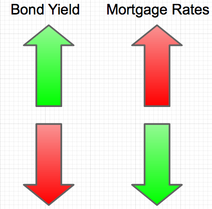
Typically, when bond rates (also known as the bond yield) go up, interest rates go up as well. And vice versa. Don’t confuse this with bond prices, which have an inverse relationship with interest rates.
Investors turn to bonds as a safe investment when the economic outlook is poor. When purchases of bonds increase, the associated yield falls, and so do mortgage rates. But when the economy is expected to do well, investors jump into stocks, forcing bond prices lower and pushing the yield (and mortgage rates) higher.

– 10-year bond yield up, mortgage rates up.
– 10-year bond yield down, mortgage rates down.

So a good way to predict which way mortgage rates are headed is to look at the 10-year bond yield. You can find it on finance websites alongside other stock tickers.  If it’s moving higher, mortgage rates probably are too.  If it’s dropping, mortgage rates may be improving as well.
To get an idea of where 30-year fixed mortgage rates will be, use a spread of about 170 basis points, or 1.70% above the current 10-year bond yield. This spread accounts for the increased risk associated with a mortgage vs. a bond. So a 10-yr bond yield of 4.00% plus the 170 basis points would put mortgage rates around 5.70%. Of course, this spread can and will vary over time, and is really just a quick way to ballpark mortgage interest rates.
There have been, and will be periods of time when mortgage rates rise faster than the bond yield, and vice versa. So just because the 10-year bond yield rises 20 basis points (0.20%) doesn’t mean mortgage rates will do the same. In fact, mortgage rates could rise 25 basis points, or just 10 bps, depending on other market factors.

Economic activity impacts mortgage rates.

Mortgage rates are very susceptible to economic activity, just like treasuries and other bonds.
For this reason, jobs reports, Consumer Price Index, Gross Domestic Product, Home Sales, Consumer Confidence, and other data on the economic calendar can move mortgage rates significantly.
As a rule of thumb, bad economic news brings with it lower mortgage rates, and good economic news forces rates higher. Remember, if things aren’t looking too hot, investors will sell stocks and turn to bonds, and that means lower yields and interest rates.
If the stock market is rising, mortgage rates probably will be too, seeing that both climb on positive economic news.
And don’t forget the Fed. When they release “Fed Minutes” or change the Federal Funds Rate, mortgage rates can swing up or down depending on what their report indicates about the economy. Generally, a growing economy (inflation) leads to higher mortgage rates and a slowing economy leads to lower mortgage rates.
Inflation also greatly impacts mortgage rates. If inflation fears are strong, interest rates will rise to curb the money supply, but in times when there is little risk of inflation, mortgage rates will most likely fall.
What other factors move mortgage rates?
Issues such as supply come to mind. If loan originations skyrocket in a given period of time, the supply of mortgage-backed securities (MBS) may rise beyond the associated demand, and prices will need to drop to become attractive to buyers. This means the yield will rise, thus pushing mortgage rates higher.
But if there is a buyer, such as the Fed, who is scooping up all the mortgage-backed securities like crazy, the price will go up, and the yield will drop, thus pushing rates lower. If lenders can sell their mortgages for more money, they can offer a lower interest rate. This explains why the Fed has purchased all those MBS. They can essentially guide mortgage rates lower, and ideally keep home prices stable, by enticing more would-be buyers into the market.
Timing is an issue too. Though bond prices may plummet in the morning, and then rise by the afternoon, mortgage rates may remain unchanged. Sometimes the bond movement doesn’t make it down to the capital markets, or it simply takes more time to do so, thus rates are unaffected. Lenders are typically cautious about lowering rates, but quick to raise them. Put another way, good news can take a while to move rates, whereas bad news can have an immediate impact. Go figure.
Tip: Mortgage rates can rise very quickly, but are often lowered in a slow, calculated manner to protect lenders from rapid market shifts.
The situation is a lot more complicated, so consider this is an introductory lesson on a very complex subject. And remember, the par mortgage rates you see advertised don’t take into account any pricing adjustments or fees that could drive your actual interest up or down considerably.
In other words, YOU matter as well. If you’re a risky borrower, at least in the eyes of prospective lenders, your mortgage rate may be much higher. Things like a poor credit score and a small down payment could lead to a higher rate, whereas borrowers with stellar credit and plenty of assets will get access to the lowest rates available.
Additionally, your mortgage rate can shift quite a bit depending on if you pay mortgage points or not, and how many points you wind up paying (are they worth it?).
Lastly, rates can vary substantially based on how much a certain lender charges to originate your loan. So the final rate can be manipulated by both you and your lender, regardless of what the going rate happens to be.

Freddie Mac’s Weekly Mortgage Rate Survey (updated 6/4/15)

Below are Freddie Mac’s average mortgage rates, updated weekly every Thursday morning:
30-Year Fixed: 3.87%, unchanged from last week (4.14% a year ago)
15-Year Fixed: 3.08%, down from 3.11% last week (3.23% a year ago)
5/1 ARM: 2.96%, up from 2.90% last week (2.93% a year ago)
1-Year ARM: 2.59%, up from 2.50% last week (2.40% a year ago)
Since 1971, Freddie Mac has conducted a weekly survey of mortgage rates. These are averages gathered from banks throughout the nation for conventional (non-government) conforming mortgages with an LTV ratio of 80 percent. The numbers are based on quotes offered to “prime” borrowers, meaning best-case pricing for the most part.
As you can see, 30-year fixed mortgage rates are the most expensive relative to the 15-year fixed and select adjustable-rate mortgages. This is the case because the 30-year fixed rate never changes, and it’s offered for a full three decades.  So you pay a premium for the stability and lack of risk.
Rates on the 15-year fixed are significantly cheaper, but you get half the time to pay it off, meaning larger monthly payments.  Rates on ARMs are discounted at the outset because you only get a limited fixed period before they become adjustable, at which point they generally rise.
You can use these average rates as a starting point when determining what rate you might be offered. If your particular loan scenario is higher risk, whether it’s a higher LTV and/or a lower credit score, it will probably be priced higher.
Record Low Mortgage Rates
In late 2012 and early 2013, fixed mortgage rates hit all-time record lows.  The 30-year fixed, as tracked by Freddie Mac, hit its lowest point ever during the week ended November 21, 2012, falling to 3.31%.  Since then, it has risen fairly steadily.
The 15-year fixed hit a record low 2.56% during the week ended May 2, 2013, the lowest point since tracking began in 1991.  It too has risen since hitting its low point.  During the same week, the 5/1 ARM also hit its all-time record low of 2.56%, though records only date back to 2005.
Finally, the one-year ARM fell to 2.41% during the week ended April 10, 2014, its lowest point on record since 1984.
Most economists don’t see rates falling back to these lows again, though anything is possible if the economy warrants such a move.

Mortgage Rate Predictions for 2015 and 2016

Wondering if mortgage rates are going up in 2015? Wonder no longer. The following are 2015 mortgage rate predictions for the 30-year fixed from well-known groups in the industry. Take them with a grain of salt because they’re not necessarily accurate, just forecasts for future movement.
Fannie Mae mortgage rate forecast: 3.9% in Q1, 4.0% in Q2, 4.1% in Q3, 4.2% in Q4 (4.4% in 2016)
Freddie Mac forecast: 3.9% in Q1, 4.1% in Q2, 4.3% in Q3, 4.5% in Q4 (4.7% Q1 2016, 4.9% Q2 in 2016)
Mortgage Bankers Association (MBA) forecast: 3.9% in Q1, 4.3% in Q2, 4.7% in Q3, 4.8% in Q4 (5.2% in 2016)
National Association of Realtors (NAR) forecast: slightly below 5% this year, 6% in 2016
In other words, mortgage rates are projected to go up, but not by a lot in 2015. The same goes for 2016, relatively limited movement, but upward trajectory.

Wednesday, May 13, 2015

2015 Rules Buyers and Sellers Must Know About Financing Flipped Properties

2015 Rules Buyers and Sellers Must Know About Financing Flipped Properties

Buying and selling flipped properties can be challenging in this market depending on the financing the buyer is trying to get. For example, many people don’t know that conventional financing or VA does NOT have an anti flip policy, but many lenders still apply their own rules, and that all FHA buyers now have to wait  over 90 days to purchase a home that was fixed and flipped by a seller. Understanding the different financing rules that are in place today for buyers and sellers and flipped properties is essential for success in today’s marketplace.
Conventional Guidelines for Financing Flipped Properties
What many people do not know, is that conventional financing does not have an anti Flip policy, so there is no limit on the amount a profit a seller can make in any given amount of time when reselling a home.
But, what buyers and Sellers needs to look out for, is lenders who will apply their own set of overlays”, which are guidelines a lender will apply on top of regular conventional underwriting guidelines to minimize their risk on the transaction. For example, there are some lenders who will ask for two appraisals, if the profit to the seller is more than 20% in less than 90 days for example.
Another issue that comes into play, is when a buyer needs to get financing over 80%, because now the buyer has to qualify for mortgage insurance “PMI”. When “PMI” companies have to get get involved in the transaction, they may want to see more documentation to justify the appreciation on the property, so be prepared to document the value increase thoroughly with supporting documentation, or once again, a particular lender may ask for a second appraisal.
Therefore, the secret to funding a flipped property using conventional financing, is to make sure the lender has No Flip Overlays.
FHA Guidelines for Financing Flipped Properties
The FHA just Discontinued their 90 Day Flip Waiver as the end of December 2014! This waiver allowed FHA buyers to purchase properties that are being resold within 90 days of being fixed and flipped. This means that all buyers wanting to use FHA financing will have to wait  over 90 days to purchase a home that was fixed and flipped by a seller.
IMPORTANT: If you are shopping for homes and looking to use FHA financing, make sure your purchase contract and loan application are dated 90 days AFTER the home was acquired by the seller, otherwise it will not qualify for financing
If there is greater than 100% profit to the seller within 180 days, the underwriter may ask for a 2nd appraisal to substantiate the value of the home. The seller will also probably have to provide proof of all the repairs done to increase the value of the property by 100%.
VA Guidelines for Financing Flipped Properties
There is also a misconception out there that the VA has their own set of rules for flipped properties. The VA does NOT have an anti flip rule, but the catch once again is, there are many lenders who will apply their own set of “overlays” (lender rules) on a flipped transaction to minimize their risk on a transaction..
So it is important ask a lender upfront what their flipped rules are, so you choose a lender who will follow the VA’s flip rules. I have several VA lenders that we are approved with, who do NOT have any additional VA rules for financing flipped properties.
Address All Concerns Upfront on a Property
A good idea is to address any concerns upfront on all flipped properties. A good rule of thumb for agents and buyers is to check the purchase date when the seller bought the property, as this will determine many of the rules above.
If the property is being resold within 90 days, this is usually where additional rules may apply, so make sure to ask the right questions.
Another good rule of thumb for buyers and agents, is to confirm with the lender if they follow regular conventional and VA’s rules for financing flipped properties, or what “overlays” would they apply on a property..
Doing this homework upfront will ensure the buyer will qualify for financing and there will be no issues getting the transaction closed for all parties involved.
If you have any questions about a flipped property scenario, please do not hesitate to contact me directly at 702-326-7866 to chat.