Monday, April 19, 2021

Down Payment Assistance is Available in Nevada (Updated for 2021)

When buying a home, the down payment is simply the amount of money you are putting towards the purchase of your home. For example on a $200,000 home, 20% down would be $40,000. That's no small amount to have or save up.  

Wouldn't it be nice to get some down payment assistance? Check out our eligibility finder. 


Despite what you've heard, a 20% down payment on a home is NOT necessary. Here’s why:

The 20% Down Myth

The myth of the 20% down payment requirement has been circulating since the housing crisis back in 2010. Access to credit tightened, even to responsible buyers who had the income to buy, but lacked a large down payment, faced the same challenges. Thankfully, the lending landscape since then has improved.

Low down payment options have been around for decades. In fact, data shows that low down payment loans with sound underwriting are just as successful for investors as loans with large down payments.

However, putting down 20% down isn’t necessarily a bad thing. It may be the right choice for you if you have the funds. It gives you 20% equity position in your home and helps you avoid paying for monthly private mortgage insurance.

Don't Get Sidelined Watching Housing Costs Rise

At the same time, saving for 20% down is keeping many buyers on the sidelines. That coupled with the high demand is rapidly increasing home prices, making it harder and harder to save for the down payment. The goal posts keep moving farther away while you’re trying to do all the right things.

There are plenty of ways for buyers to make themselves more competitive in a tight market. One is using a low down payment loan, along with down payment assistance. This way, you can leverage and diversify your other investments so all your money isn’t in one asset—your home.

What Are Your Options?

Wait and save. I read an article that it’s estimated to take the average person 14 years or more to save for a 20% down payment. That’s more than 14 years for your pay rent and see home prices and interest rates rise, too. And 14 years later, you’ll have zero equity in the place you live, wiping out your next generation’s wealth-building potential.

Find down payment assistance programs. The majority of DPA programs provide down payment and closing cost assistance, helping with some or all of your costs. There are about 2,300 homeownership programs available across the US, including grants, forgivable loans, below-market first mortgages, tax credits and more.

The average down payment program benefit across all programs is more than $7,500. Just remember that both the home and the homebuyer must qualify for the program so do your research early.

Get pre-approved with a low down payment mortgage. There are several options for buyers today. Keep in mind that you can layer down payment programs with these loans.

  • FHA loan: Popular with first-time homebuyers, it allows a 3.5% down payment minimum.
  • VA loan: If you are a veteran or member of the U.S. military, look into a VA loan which offers 0% down.
  • USDA loan: Eligible in rural and suburban areas, it offers 0% down.
  • Home Possible: Freddie Mac’s low down payment loan allows down payments of 3% to 5% and flexible sources of funds for down payments.
  • HomeReady: Fannie Mae’s new loan program that allows a 3% minimum down payment for first-time buyers. 
  • Conventional loans with private mortgage insurance: Allows 3% down payment minimum. PMI will be required if you put down less than 20%. However you can get rid of the PMI once you’ve accrued over 20% equity in your home down the road.

You are Unique - “No One Size Fits All”

For home loans, there’s not a “one size fits all” or right choice for everyone. Like you, your finances and home buying goals are unique. That’s why it’s important to secure your home financing before you tour that dream home.

Begin by investigating your options early: talk to an experienced local lender to get pre-approved, search for homeownership programs in your area and talk to your real estate agent.


Let us know how we can further assist you. Our DPA eligibility tools can help you find DPA options that you might be eligible for. 


Best wishes to a successful homebuying journey! 


Aundrea Beach-Greco 

Mortgage Lender, CMPS 

NMLS 333739

📱 +1 702-326-7866

📧 info@aundreabeach.com

🌐 www.AundreaBeach.com

.

.

#HomeLoansForEveryone #AundreaBeachGreco #AundreaBeach #thebeachgrecoteam #AdviceMatters #Mortgage #Mortgages #MortgageLender #MortgageRates #Realestate #Home #Refinance #Equity #Loans #Credit #CreditRepair #LasVegas #Nevada #Investment #Properties #Homebuying #HomeForSale #DreamHome #NewHome #Homeloans #Finance #BuildWealth #FinancialFreedom


Aundrea Beach-Greco, CMPS. Licensed Mortgage Loan Officer. NMLS 333739

702-326-7866 info@AundreaBeach.com

Find me online www. AundreaBeach.com

Apply online at www.iLendLasVegas.com


Wednesday, February 17, 2021

When can I remove PMI on my mortgage?


What is PMI (private mortgage insurance)? 

First, a little background: PMI is typically required on conventional loans where the borrower puts down less than 20% of the property’s contract price. (The term “conventional” refers to any loan that’s not part of a government program).Ultimately, PMI protects lenders if you default on the loan. If — for any reason — you’re unable to keep up with your mortgage payments and the property goes into foreclosure, PMI will help to cover the balance of the outstanding loan when the home is sold at auction. Most homeowners who carry PMI have borrower-paid private mortgage insurance, which they pay as an additional monthly fee with their mortgage.

Homeowners Protection Act of 1998

As you build up your home equity, there are several paths to removing PMI. Under rules outlined by the Homeowners Protection Act (PMI Cancellation Act) of 1998 or HPA, you should be able to initiate PMI removal once the principal balance of your mortgage drops to 80% of the original value of your loan. The HPA gives you the right to remove PMI from your home loan in two ways. You can get “automatic” or “final” PMI termination at specific home equity milestones, or you can request the removal of PMI when you reach 80 percent home equity.

3 Ways to get rid of PMI

Option 1: Pay down your mortgage for automatic or final termination of PMI.

Under the HPA, the mortgage lender or servicer is required to drop your PMI when one of two things happens: The provider must automatically terminate PMI when your mortgage balance reaches 78 percent of the original purchase price, provided you are in good standing and haven’t missed any scheduled mortgage payments.

Option 2: Request PMI cancellation when mortgage balance reaches 80 percent.

Instead of waiting for automatic cancellation from your lender, you have the right to request that the servicer cancel PMI once your loan balance reaches 80 percent of the home’s original value. If you’re making payments as scheduled, you can find the date that you’ll get to 80 percent on your PMI disclosure form or request it from your loan servicer. Make sure the PMI cancellation request to your lender in writing.

Option 3: Refinance to get rid of PMI

When mortgage rates are low, you might consider refinancing your mortgage to save on interest costs or reduce your monthly payments. At the same time, refinancing might enable you to eliminate PMI if your new mortgage balance is below 80 percent of the home value. It’s a double dose of savings.

The refinancing strategy works if your home has gained substantial value since the last time you got a mortgage. For example, if you bought your house four years ago with a 10 percent down payment, and the home’s value has risen 15 percent since then, you now owe less than 80 percent of what the home is worth. Under these circumstances, you can refinance into a new loan without having to pay for PMI.

With any refinancing, you’ll want to weigh the closing costs of the transaction against your potential savings from the new loan terms and eliminating PMI.


Your PMI rights

Homeowners who pay for PMI should be aware of their rights under the Homeowners Protection Act. This federal law, also known as the PMI Cancellation Act, protects you against excessive PMI charges. You have the right to get rid of PMI once you’ve built up the required amount of equity in your home. Lenders have different rules for cancelling PMI, but they have to let you do so.

Before you sign a mortgage with PMI, ask for a clear explanation of the PMI rules and schedule. This will enable you to accurately track your progress toward ending the PMI payment. If you feel your lender is not following the rules for eliminating PMI, you can report your complaint to the Consumer Financial Protection Bureau.


Contact us for more info: 

Aundrea Beach-Greco

Mortgage Advisor, CMPS | NMLS 333739

CMG Financial | NMLS 1820 

8337 W. Sunset Road, Suite 300, Las Vegas, NV  89113

(702) 326-7866

info@AundreaBeach.com | www.AundreaBeach.com

www.AundreaBeach.com

Monday, September 21, 2020

What's the Difference: Homeowners Insurance and a Home Warranty

When buying a home, so many new terms are thrown at you and sometimes your realtor and lender think you know what the heck they're talking about. Some terms are interchangeable and it can get super confusing to keep them straight. 

So, what is the difference between homeowners insurance and a home warranty and do you really need them?


Owning a home is the one of the greatest investments you'll make in your life. Protecting your assets is not just smart—it's essential. The best way to do this is to have both a homeowner’s insurance policy and a home warranty. Purchasing both will cover your home, belongings, appliances and system components in case they need replacement or repair. But understanding the differences of the two products and why you need them can be tricky.


WHAT DOES A HOME WARRANTY COVER?

A home warranty may help cover the repair or replacement of a broken appliance. A home warranty may also cover what the Federal Trade Commission (FTC) calls "limited coverage of workmanship and materials" for specific parts of the house in a new home. A home warranty may also cover plumbing or electrical work.

What's excluded from home warranty coverage? According to the FTC, home warranties may not include components "covered under a manufacturer's warranty." If your new furnace breaks down, then you would likely have to discuss a repair with the manufacturer of your furnace system.

A home warranty isn't a blank check for repairs or replacements. According to the FTC, a home warranty may also have rules regarding how homeowners can make a claim, and might also delineate how an item, such as a furnace, will be repaired or replaced. Some warranties might specify which repair companies may complete a repair.

While a home warranty may be a worthwhile purchase for a homeowner, home warranty coverage is "never required." 

WHAT DOES HOMEOWNERS INSURANCE COVER?

While a home warranty may provide coverage for an appliance that's stopped working, what happens if someone steals your belongings or your home is damaged by fire?

A typical homeowners insurance policy may help pay to repair your home or replace your personal property after a covered event (also known as a peril) such as theft or fire. However, homeowners insurance typically will not provide protection if, for instance, your air conditioner or other appliance breaks down or is defective.

Homeowners insurance typically also comes with liability coverage, which may help pay legal fees or medical bills if you're found responsible after a visitor is injured at your home.

It's important to note that coverage limits will always apply. A local insurance agent can help you determine whether you have enough protection in place should you experience a loss.

A home warranty and a homeowners insurance policy offer different types of coverage that may give you peace of mind as you consider certain scenarios. To learn what your homeowners insurance policy may help protect — and what it may not — talk with your local insurance agent.


Reach out if we can assist you!

Aundrea Beach-Greco
Mortgage Advisor, CMPS
NMLS 333739
(702) 326-7866
info@aundreabeach.com
www.AundreaBeach.com


CMG Financial - NMLS 1820 
8337 W. Sunset Road, Suite 300
Las Vegas, NV  89113
Office (702) 777-1306


Tuesday, August 25, 2020

Rules For Giving & Receiving Gift Funds for Your Down Payment


Here's what you need to know about giving and receiving gift funds.


Saving a down payment is one of the most challenging—aspects of buying a home. The larger your down payment, the less you have to finance, which can lead to lower interest rates and monthly payments over the life of your loan. Furthermore, with a 20% down payment or more can help you avoid costly private mortgage insurance. 


If you're ready to become a homeowner, asking your family for help with your down payment may have crossed your mind. While down-payment funds can be gifted between family members, you must follow a list of rules to document the gift, including a down payment gift letter. 

If you’re lucky enough to get down-payment help this year (or generous enough to give it), be sure you know the rules around gift funds. It’s not as simple as handing over a wad of cash with a note that says “Congrats! Here’s a little something for your new house.”

Down payment gift funds must meet certain requirements or the gift giver and recipient face trouble down the road. From writing a gift letter to rules around repaying gift money, here are basic facts homebuyers and donors should know.

Who can gift a house down payment?

It might seem odd that there are restrictions around who can give someone money for a down payment. After all, money is money, right? Not necessarily. Cash can come with strings attached, which might affect the borrower’s ability to repay the mortgage.

How much money can you receive as a gift?


Many home loan programs allow some or all of a down payment gift to come from a variety of sources. You can get gift money from a relative, friend, your employer, local labor union, government agency or even a charitable organization.

The amount of gift funds you can apply to your down payment depends on what loan program you select. Here’s a look at the most common options.

Fannie Mae gift funds. 

Fannie Mae guidelines allow approved lenders to offer conventional loans, the most common type of home loan taken out in the U.S. The minimum down payment for a conventional loan is 3%, and the entire amount can come from a gift for a one-unit primary residence. A 5% minimum down payment from your own funds is required if you’re buying a two- to four-unit property.

Freddie Mac gift funds. 

Similar to Fannie Mae, Freddie Mac provides funding for conventional loans. Under Freddie Mac guidelines, your entire down payment can be gifted by a relative if you’re buying a single-family home as your primary residence. You’ll need to come up with up to 3% of your own down payment funds if you’re purchasing a two- to four-unit property with less than 20% down.

FHA gift funds. 

The Federal Housing Administration (FHA) insures loans made by FHA-approved lenders and allows the entire 3.5% down payment to be gifted. An FHA gift letter paper trail is required, with supporting documents resembling conventional guidelines. FHA loans, which have lower credit score requirements and a low down payment requirement, can help first-time homebuyers who need more flexible borrowing guidelines.

VA gift funds. 

The Department of Veterans Affairs (VA) guarantees home loans for eligible active and retired military borrowers. VA loans do not require a down payment, but the program does allow borrowers to use gift funds toward a down payment if they want to make one. The gift letter and documentation requirements are similar to FHA and conventional loans.

USDA gift funds. 

Families with low- to moderate-incomes can purchase homes in rural areas of the U.S. using the U.S. Department of Agriculture’s mortgage program. Like the VA loan program, USDA loans require no money down. Gift funds are permitted with a properly completed down payment gift letter and supporting documents consistent with FHA, VA and conventional lending rules for gift letters.

How Does Using Gift Money for a Down Payment Work?

You can use gifted funds to make a down payment, but the mortgage lender will want to know some details before they allow you to use it. Only two specific groups can give a home buyer money to fund their down payment.

  • A family member — as long as they can prove they have a standing relationship with the buyer
  • Government organization — as part of a program meant to get first-time buyers into the market

You must confirm the relationship between you and the gift giver.

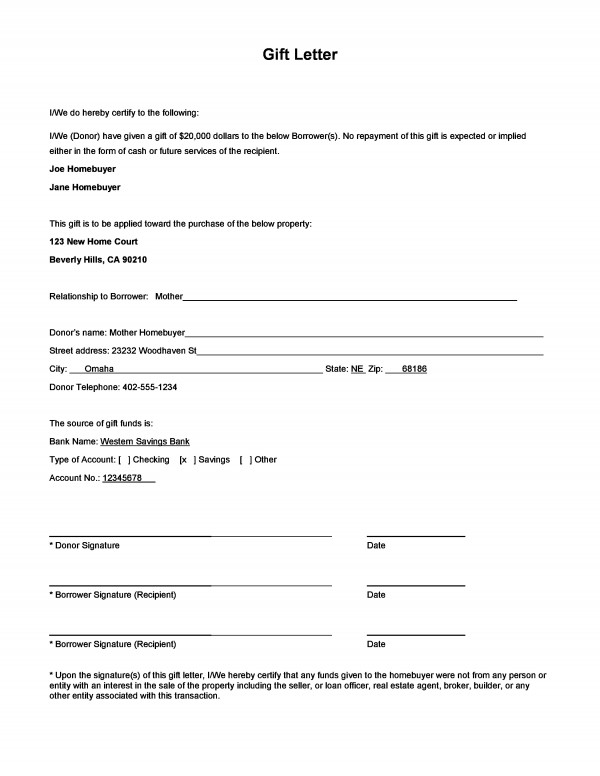
If you plan on getting gift funds from a family member, you’ll need a letter that confirms your relationship and that the money is a gift and not expected to be repaid. Usually this is in the form of a gift letter, which both parties sign.  Your lender will provide the required format.


Gift Letter Sample

Sample Gift Letter

The lender will also require further evidence of the gift — for instance, they will ask to see the donor's bank statements to show they have the funds to give the buyer as much money as is promised. They may also ask for a bank slip from the buyer’s account to show when the money was transferred, and a bank statement from the borrower after the money is deposited.

Often, gifts change hands during the application process — this gives time for the money to show up on both the donor and the buyer’s bank statements as well as gives the mortgage lender time to verify that the money is from a legitimate source and the pair has an appropriate relationship.

If the gift funds are added to the buyer’s bank account after settlement, then documentation will still be required before it can be applied to the purchase. Typically, this will require a receipt of the cashier’s check as given to the closing agent.

Can you pay back a mortgage gift?

The answer is NO. This is considered mortgage loan fraud, which is a crime. It can also put your loan qualification at risk as all loans need to be factored into your debt-to-income ratio.

The moral of this story: Be honest with your lender about where you’re receiving all funds for your down payment — as they’ll likely find out anyway.

What Else Should You Know About Down Payment Gifts?

As previously mentioned, there’s a difference between receiving a down payment gift and a loan. Buyers need to be clear with their mortgage lenders and confirm that the money received was gifted. A sudden infusion of cash without a traceable source will leave lenders suspicious and, perhaps, wary of completing the loan deal on their end.

Buying a Home is More Than a Down Payment

Ultimately, the cost of the down payment is only one expense to consider in the home-buying process. Homebuyers need to pay for closing costs, which include expenses like an appraisal, credit report, and underwriting fees.

The Do’s and Don’ts of a Down Payment Gift

Do…Don’t…
Get a signed statement from the gift giverTell the lender the funds are a gift when it’s a loan
Remind gift giver to keep a paper trailChange or add money without explanation
Get the money in advance and know how seasoned money worksAssume all loan types allow down payment gifts
Understand the monetary limit of gift funds for tax purposesNeglect the mortgage because you have no money in the game

Down payment gifts can make it easier for homebuyers to afford a home.

If you’re in the market for a new home and want a little help, don’t hesitate — just make sure you follow the above steps to ensure you accept such a gift in the proper manner. When you speak with your lender about what loan is best for you, make sure you let them know upfront that you plan on using gift funds for the down payment. Some loans have strict guidelines on how much gift money you can use for a down payment and who can gift you the money.


Reach out of you have questions or need help! 


CMG Financial | NMLS 1820

8337 W. Sunset Road, Suite 300

Las Vegas, NV  89113

Office (702) 777-1306


Aundrea Beach-Greco

Mortgage Advisor, CMPS

NMLS 333739

(702) 326-7866

info@aundreabeach.com

www.AundreaBeach.com


Thursday, August 13, 2020

How To Shop for a Mortgage without Hurting Your FICO® score

Shopping around to make sure you find the best deal on a loan is smart. Getting the best interest rate and terms possible, could save you thousands or even tens of thousands of dollars over the life of a mortgage loan. A home loan is unique like you and I ... so its best find a lender where you can explore what kinds of options might be out there.

Each time you apply for a home loan, a mortgage lender will make a credit inquiry to review your credit history. These inquiries are reported to the three major credit-reporting agencies: Equifax, Experian and TransUnion.  Because inquiries signal that you are thinking of taking on new debt, your credit score can dip. But the good news is that the damage from multiple credit checks by mortgage lenders is typically small.

That being said, it’s best to keep your interest rate shopping limited to a short window of time if your credit reports are being pulled as part of the process. There is a chance that rate shopping could have a negative impact on your credit scores.

What is a credit inquiry?

An inquiry is a record of access into your credit profile. So, when you apply for credit, the credit bureaus are going to make a record of who accessed your credit report and when, and place that record on your report.

Some inquiries, such as checking your own personal credit, do not affect your score. These are referred to as “soft” inquiries. Other inquiries, such as applying for new credit, such as a car, credit card or home loan have the potential to impact your scores negatively. These are referred to as “hard” inquiries.


The sole reason the credit scores exists is to help lenders predict risk. And research shows that applying for multiple new accounts in a short period of time is predictive of elevated risk.

Due to this fact, credit scoring models like FICO and VantageScore are designed to pay attention to the number of hard inquiries on your credit reports when calculating your scores. And a larger number of hard inquiries could translate into lower credit scores in some cases.

The exception to this rule is when you’re rate shopping. Your credit reports could easily get polluted with multiple hard inquiries in a short period of time when you’re trying to find the best financing offer available. But credit inquiries that occur as a result of rate shopping are not indicative of the same elevated risk mentioned above.

As a result, credit scoring models often treat them differently — provided that those inquiries all occur within a certain window of time and are from certain types of lenders. Both FICO and VantageScore scoring models include logic that protects your scores from the impact of rate shopping inquiries.

Shopping window within 45 days

In the FICO model, multiple credit inquiries within a 45-day window are treated as one shopping event, provided those inquiries are from mortgage, auto loan or student loan lenders.

For example, FICO can see you are rate shopping for a home loan, so they will count as one inquiry, as long as the applications all take place within their 45-day window.

Inquiries outside of the three categories mentioned above, such as credit card inquiries, are not protected, because consumers don’t typically shop around for the best rate on a credit card. 

Be mindful of your credit applications and only make a credit inquiry when necessary.

Even if you have a few credit inquiries that are counted against your scores, we’re talking about a minimal number of points deducted, and even that impact will disappear within a year. Credit is cyclical and within a few months, your score will bounce back a little, as long as there aren’t other negative factors on your credit report. So, keep the hard inquiries down to a minimum to minimize the small effect they do have on your credit report.

Have a specific question? 

Reach out. 😊


Aundrea Beach-Greco
Mortgage Advisor, CMPS
NMLS 333739
(702) 326-7866
info@aundreabeach.com

CMG Financial - NMLS 1820 
8337 W. Sunset Road, Suite 300
Las Vegas, NV  89113
Office (702) 777-1306

www.AundreaBeach.com

Monday, July 27, 2020

HEROES - Home Buyer and Refinance Loan Program


Emergency Personnel Save Through the NEVADA First Responder Appreciation Program

Emergency service teams help to keep our local communities safe with immediate response measures and direct care. CMG Financial thanks you for playing a critical role in making where we live both secure and comfortable. Feel free to maximize value and save more on your next home purchase or refinance with the Beach-Greco Team, all part of the CMG Financial First Responder Appreciation Program.
What Does the First Responder Appreciation Program Offer?
Qualifying members of the First Responders Association get to take part in this savings-oriented program, utilizing up to 4% towards your down payment and/or closing costs on your new home purchase in NEVADA. Experience the difference with CMG Financial. 
Pair additional incentives and eligible offers to maximize value and save even more.

Who Qualifies to Participate in this Program?
The following parties are eligible to save more through this program:
  • 911 and Fire dispatchers
  • Police Force (includes police officers, sheriffs, sheriff's deputy, correctional officer, state trooper)
  • Federal Law Enforcement (includes those working for Central Intelligence Agency, Department of Public Safety and more - check with team for other organizations that qualify)
  • Firefighters (includes both career and volunteer)
  • EMT (includes EMT and paramedics team)
CMG Financial - Where First Response Team Members Save More
Save more through the CMG Financial First Responder Appreciation program here in NEVADA when you choose to buy or refinance your home. Contact our team for additional specifics, as we can process program eligibility and secure your bonus money today.

See if you're eligible

Aundrea Beach-Greco
Mortgage Advisor, CMPS
NMLS 333739
702-326-7866
info@aundreabeach.com
www.AundreaBeach.com

Thursday, July 23, 2020

Housing Assistance Available for Nevadans

This is from Senator Catherine Cortez-Masto's office
7/23/2020
Fellow Nevadan,

I know that this is an extremely difficult time for homeowners and renters across our state. The coronavirus pandemic has impacted the health and economic security of so many of our families. Many of you have had your lives upended by the coronavirus pandemic and are looking for information and resources to stay in your homes.  

On June 25, the state of Nevada began gradually lifting the pause on evictions that Governor Sisolak ordered on March 29. This gradual lift only permits certain types of evictions before September 1, 2020, when the suspension lifts completely. To support Nevadans in need of housing assistance during this challenging time, Governor Sisolak has dedicated $30 million in CARES Act funding to rental housing assistance and $20 million in commercial rental assistance across the state of Nevada.

If you find yourself without income to pay your rent or mortgage, be sure to reach out to your landlord or lender immediately. There are government and nonprofit resources that can help Nevadans catch up on payments:
  • The Nevada Housing Division and State Treasurer Zach Conine have launched the CARES Housing Assistance Program to assist individuals and families impacted by COVID-19. 
  • The city of North Las Vegas offers short-term and long-term rental assistance to lower-income households. Find out if you qualify for the assistance here.
  • If you believe you were wrongly issued an eviction notice during the moratorium, you can file a complaint with the Nevada Attorney General’s office.
You can also take a look at additional housing resources throughout Nevada below:
Nevada Partners – Rental and Utility Assistance Program
Phone: (725) 735-2924 
Website - nevadapartners.org

Nevada’s Hardest Hit Fund - Unemployment Mortgage Assistance Program
Website - nahac.org

Civil Law Self-Help Center
Phone: (702) 671-3976
Website - civillawselfhelpcenter.org/self-help/evictions-housing

Money Management International  
Phone: (866) 232–9080
Website - moneymanagement.org

Opportunity Alliance Nevada
Phone: (775) 333-8274
Website - opportunityalliancenv.org/contact-us/

Neighborhood Housing Services of Southern Nevada
Phone: (702) 649–0998
Website - nhssn.org
Always remember that my office is here to help you. If you have any questions, you can reach out to my office through my website or by calling one of my offices in Nevada or Washington, D.C. I want to ensure that renters and homeowners have a safe place to live and that property owners can stay afloat to provide that housing. In Washington, I’m fighting to provide more federal dollars for housing assistance to avoid an increase in homelessness. During this pandemic, we know that housing is health care.

For information on housing or other topics, visit my website at cortezmasto.senate.gov for more resources like my COVID-19 Disaster Resource Guide.