Sunday, February 23, 2020

Retiring in Las Vegas

RETIRING IN LAS VEGAS

When getting to retire to a new place... Ask yourself these important questions:

How does the cost of living compare to other cities?
Do I see myself living my best life here? Are there activities that interest you? Will you enjoy the year-round climate?


Are you thinking about retiring in Las Vegas? 


Las Vegas is a fantastic place to retire and live out your golden years. In this amazing stereotyped city, there is something for everyone - all year long. 

Whether you like sporting events, concerts, shows, or the peace and quiet of the outdoors, Las Vegas is worth taking a serious look at for your retirement. In fact, the state of Nevada often appears in Top 10 lists for the best places to retire. 
The greater Las Vegas-Henderson area is so much more than just the Strip and cocktails. There are plenty of relaxing and quiet neighborhoods for you to live with a large range of activities – from golfing to hiking – to keep you busy.
Before you retire, you want to do your homework and consider the cost of living of all of the potential cities or towns that you are considering retiring in. 

LAS VEGAS WEATHER

Las Vegas has amazing weather for the majority of the year and yes, the summer is hot, it’s a dry heat, with single or low double-digit humidity.  In fact, many people from humid regions of the world, love the Las Vegas heat for its dryness. And people from the bitter cold states of the midwest and northeast love our extremely mild and sun-soaked winters. 
Summer: Beginning in June, average highs hover around 102° F and July sees average highs of 107° – it takes a little getting used to but once accustomed, people just go about with their daily routine: golf, a walk in the park, or a trip to their favorite restaurant. You aren’t going to sweat like you would in the southern or eastern U.S. 
Winter: The winter months are simply hard to beat, especially if you are not a fan of bone-chilling cold and snow-covered highways. Retiring in Las Vegas will help you avoid the snow. At a maximum, you may see some snowfall of a few inches within the city every few years.  Snow can be seen on the mountain peaks of the surrounding Red Rock mountains. And if you want to spend some time in the snow, you can take the quick 1-hour drive to Lee Canyon or Mt. Charleston. 
Average highs in November, December, January, and February are 70°, 60°, 59°, and 66° F respectively. It can get chilly at night, however.  
Winter in Las Vegas truly is a great way to spend retirement!

LAS VEGAS ENTERTAINMENT

MUSIC AND SPORTS

Las Vegas is known for its world-class entertainment that draw millions of visitors to the city.  Then there are the concerts. If you have a favorite artist chances are that they will tour through Las Vegas. We see names big and small, domestic and international, added with several music festivals throughout the year. 
Las Vegas sport is evolving and finally, the city has the NHL Golden Knights and the new NFL Las Vegas Raiders in 2020-2021. 
Boxing and the UFC are common headliners and Las Vegas hosts the biggest and most important fights in the world. 
Other entertainment venues and events to enjoy your Las Vegas retirement include the NFR Rodeo every November, the UNLV sports teams, NBA Summer League, and international soccer friendly matches. 

DO YOU LIKE THE OUTDOORS?

If you want something other than sports, shows and concerts, you can get away and enjoy the beautiful Nevada outdoors. 
Outdoor spots in the Las Vegas Valley can include:

  • Red Rock Canyon
  • Colorado River
  • Hoover Dam
  • Lake Mead
  • The Arizona Hotsprings, Lake Mead Recreational Area
  • Lake Las Vegas
  • Valley of Fire
  • Mount Charleston 
  • Lee Canyon

Being retired in Las Vegas puts you in close proximity to the Grand Canyon, Zion National Park, and Arizona, Utah and California.  
Other activities may include a round of golf, a tennis match, or hopping on your bike to see some trails for some exercise.

DO YOU LOVE FOOD?

Vegas locals have some many selections when it comes to food. There are famous stops as well as the normal run of the mill chain restaurants depending upon your taste. 
You can enjoy American, Thai, Japanese, Korean, Chinese, Cuban, Mexican, Brazilian, Italian, Philipino, German, and British cuisine all over the city and on every night of the week. 
If buffets are your thing, well then, Las Vegas has plenty of theose for breakfast, lunch, or dinner. 
And if you are a true foodie, you won’t want to miss the Las Vegas Food Expo, held in October of every year at The Mandalay Bay. 

THE FINANCIALS ASPECT OF RETIRING IN LAS VEGAS

LAS VEGAS TAXES

Nevada is considered a "tax friendly" state. This is a major reason people move to the state to live, work, and especially to retire in Las Vegas. 
Let’s look at how taxes are treated in the state of Nevada:

  • -No personal income tax
  • -Social Security income is not taxed
  • -Pension income is not taxed
  • -Withdrawals made from retirement accounts aren’t taxed
  • -Sales tax is roughly 6-8% (Clark County has the highest rate)
  • -No inheritance or estate tax

-Property tax in Clark County actually has one of the higher median property tax rates in the country. It currently runs around 3.3% of the assessed property value.
-However, the county offers certain tax abatements so the effective rate is closer to 0.72% – 0.92% of assessed property value. 

LAS VEGAS, NV COST OF LIVING

A Las Vegas retirement would allow you to live in a state and a city with an attractive cost of living. 
Let’s look at some numbers.
According to Zillow.com, the median home price in Las Vegas hovers around $270,000 – although the median price was $300,000 in January of 2019. This is slightly above the national median home price.
Utility prices, according to payscale.com are 10% lower than the national average.
The average internet cost is approximately $68.28 per month.
You can enjoy bang for your buck when it comes to food prices – either at the grocery store or at a famous Las Vegas buffet.
Transportation is, unfortunately, not the best here in Las Vegas. Of course, it all depends on how far you need to travel.
If you have to get from one side of the city to the other, it’s going to take a long time. There is no light rail train (not counting the inter-casino Monorail) like in other cities to help you with a commute. A monthly bus pass costs $65, or $32 for seniors.
Car insurance in Las Vegas can be a little pricey, with the city average being approximately $1,600 -$2,000 a year whereas the national average is just shy of $900 per year.

ARE YOU READY TO RETIRE IN LAS VEGAS?

Retiring in Las Vegas has so many perks. The city and surrounding areas are truly special and that’s why I love living here!
If you have questions about your retirement planning, don’t hesitate to contact me!

Check out my YouTube channel and videos about Retiring in Las Vegas! 

Aundrea Beach-Greco
Mortgage Advisor, CMPS
702-326-7866
www.AundreaBeach.com

Friday, February 07, 2020

Top 5 Down Payment Myths Debunked

Top 5 down payment myths debunked

More markets are looking at affordable housing strategies to attract and retain important services.
Down Payment Resource, the nationwide database for homebuyer programs, released its Fourth Quarter 2019 Homeownership Program Index (HPI). The latest HPI data debunks five common down payment myths that may be keeping buyers on the sidelines longer than necessary.

Myth #1 - 
You need 20% down to buy a home.
A survey found that 41% of people believe a high down payment is required to purchase a home. In fact, there are many low down payment loans and programs available. New data shows that a lower down payment may even be better for many new buyers, as it provides a valuable cash cushion. Research by the JPMorgan Chase Institute found that liquidity — having at least three months of mortgage payments available — is a better measure of homeownership success than a large down payment. 
There are a wide range of homeownership programs that can help with the down payment and closing costs.

Myth #2: Down payment help is only for first-time homebuyers.


The industry often associates homeownership programs with first-time homebuyers, but eligibility is actually broader. The official definition of a first-time homebuyer — according to HUD — is someone who hasn't owned a home in the last three years. In addition, the HPI reports that 41% of homeownership programs do not have a first-time homebuyer requirement and are available for eligible repeat homebuyers.
Myth #3: Down payment programs aren’t available in my area.
Down payment programs are available in every market across the country. The HPI reports 70% of programs are available in a specific local area, such as a city, county or neighborhood and nearly 30% of programs are available state-wide through state housing finance agencies — a 2% increase from the previous HPI. States with the greatest number of down payment programs remained consistent —California, Florida and Texas are the top three.
View a complete list of state-by-state program data.
Myth #4: It’s too expensive to buy a home in my market.
Down payment help is available in every market, including high cost areas. The HPI reports that 11% of programs offer incentives and even specific programs for community service workers, including educators, police officers, firefighters and healthcare workers — a 3% increase from the previous HPI.
Plus, more than 6% (6.3%) of programs have benefits for veterans, members of the military and surviving spouses. These programs can also be layered with zero down payment VA loans.
One-to-four unit multi-family properties can also qualify for down payment help. 25% percent of programs allow buyers to purchase a multi-family property as long as the buyer occupies one of the units, which allows the homeowner to earn income from their rental units to help pay the mortgage.
Myth #5: Down payment programs make home financing more difficult.
There are 2,451 homeownership programs available in the nation and 83% currently have funds available to eligible homebuyers. Exploring home financing options should be the first step for prospective buyers, however, they don’t have to go it alone — housing agencies, program administrators and participating lenders can provide expert guidance.
Homebuyers can get a jump start by completing the homeownership education course typically required to qualify for a program. This education is usually free, online and gives buyers confidence with the home buying process, financing options and budgeting. Homebuyers should refer to the specific requirements and education providers as specified by the program.
After a homebuyer is approved for a program, the agency will provide documentation that can be submitted with an offer. Sellers can also benefit because the down payment program may help cover closing costs.

Let's see what your eligibility is TODAY! 
Contact us.
702-326-7866
info@aundreabeach.com
www.AundreaBeach.com

Aundrea Beach-Greco
NMLS 333739
Mortgage Advisor, CMPS

Sunday, January 12, 2020

Why Your Credit Score Is Different Depending On Where You Look

When you check your credit score, you may have wondered WHY your score is different depending on where you check it. Here's why!
These 3 numbers have a impact on your life, from your ability to get a car loan or a mortgage to your chances of being denied an apartment or even a job? This is your credit score.
If you haven’t thought about your score until now, you need to start tracking it. After all, there are plenty of tools (both free and not free) for doing so. 
First, let’s talk about what exactly a credit score is.
Credit bureaus
Since its creation in 1989, the FICO® Score has been the most commonly used assessment of creditworthiness. FICO® Scores are generated by a proprietary scoring algorithm, which empowers lenders to make informed decisions about risk and protects borrowers from unfair bias. This is why FICO® is considered the industry standard.
What Is A Credit Score
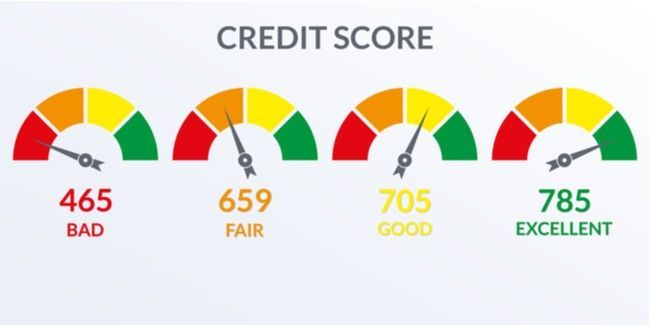
The base FICO® Score range is 300-850. Higher is better and anything above 600 is generally considered “fair.” Lenders equate your score with the level of risk they’d take by extending credit to you. A higher score means lower risk, better terms and vice versa.
This is why your credit score is so important, not only for credit approval but also for things like your credit limit and the terms of the loan.
The last thing you should know about credit scores is that, while FICO® Scores are used by the majority of lenders, there are also alternatives to the FICO score.
For example, some companies base its credit scores on the VantageScore model. Whichever model you or your lenders use, your credit score is actually three different scores, each based on your credit reports from the three bureaus (Equifax, TransUnion, and Experian).
As mentioned above, your credit score may vary slightly depending on the credit agency it comes from and the scoring algorithm used.
When you apply for credit, a lender may use a specific score (such as FICO) or an average of your various scores (FICO & Vantage).
So, focus on what you can control: Factors such as your length of credit and payment history and your credit utilization. If a crisis causes your score to go down, you can rebuild it in the same way you would originally create and maintain good standing.
According to some, your FICO summarizes your credit history…based on your financial decisions.  As mentioned above, that history is reflected on your three credit reports.
Here are the most common factors used in credit score algorithms:
This is when you apply for a credit card or other type of loan and the lender pulls your credit report as part of the decision-making process. A hard inquiry usually lowers your score, so the more inquiries you have, the bigger the impact.
They also remain on credit reports for about two years, so be mindful and strategic when you need to apply for new credit accounts.
It’s good to have at least a few accounts (but not too many) and variety of account types is also important. Lenders want to see that you’ve used different types of credit without problems. 
Also known as your balance-to-limit ratio, this is simply the percentage of your total credit limit in use at any given time. 30% or below is the target.
Higher percentages signal to lenders that you’re having trouble paying off your cards or spending more than you make, both show potential risks.
These consist of a range of “red flags” from late bill payments to credit accounts in collection and bankruptcy filings. These blemishes can stay on your report for up to a decade, so try to avoid those at all costs.
One easy way to avoid late payments is to sign up for autopay on all of your accounts, from utilities to credit cards.
Paying your bills on time is one of the most important ways to build and maintain a good credit score. This isn’t limited to debt payments either. Late payments to a utility or cell phone account can also lower your score.
After reading this article, you’re probably curious about your own scores and credit history. Here’s where you can find them:
Federal law entitles you to a free annual report from each of the three major reporting agencies. However, this doesn’t include a free credit score.
To obtain your score from TransUnion, Experian, or Equifax, you have to sign up for one of their monthly subscription plans. These range in price from $16.95-$24.95/month. 
It is a good idea to get an idea of your credit scores and what is on your credit report so when the time arises to apply for something you aren't shocked at the score you see.
We can help if you are planning to buy a home in the future, let's get you a mortgage credit report, and a mortgage plan in place.
How much do I qualify for? (Get the App) See what you qualify for!

Saturday, November 30, 2019

5 Step - Rent Vs. Buy Decision Process


1. Check out the individual market trends online using Trulia or Zillow 

This is a simple way to analyze any real estate market, and you can actually get super granular and zoom into more defined neighbors to do you own specific rent/buy calculations. Zillow and Trulia do not provide up-to-the-minute data like a Real Estate Agent but you can get some preliminary information to start your search. I highly recommend getting connected with a real estate agent. 
Diving a bit further into the data it shows that the Las Vegas market is growing like most real estate markets in the US have been growing over the past few years. So while you wouldn’t be buying at the bottom of the market, the data is pretty compelling that buying a house is more affordable than renting – even if you only live in the place for 2 years.

2. Determine how long you are going to live there (it can be less than 5 years)

MYTH BUSTING TIME. Some say that you should ONLY buy a house or a condo if you are going to live in it for at least 5 years. This is just plain wrong! I think it makes sense to buy even if you are only going to live in a place for 2+ years in some markets.
And even if once you do all of the calculations that say you should be renting instead of buying, buying probably still makes more sense. Who knows, maybe you will end up living your city longer or you could keep your home and rent it out if you have to leave. Always lean towards buying a home if the numbers work.  

3. Determine your potential down payment (it doesn’t have to be 20%)

ANOTHER MYTH: Too many people wait to save up 20% before buying a home. You don’t need 20%. After I had a client having only $200.26 in their bank account,  I finally had helped her save up a decent amount of money to afford at least a 3% down payment with some additional padding for an emergency fund.
Yes, she only put 3% down on a condo and she bought as quickly as she could because she was certain that prices were going to keep going up. Yes, she had a lot of advantages buying when the market was still level, but if she had waited one year until she had 20% saved then she would have missed out on at least $125,000 in growth.
The reason she felt comfortable doing this was because she was confident in her  income growth in the future. Think careful if your job is secure and if you can afford to buy a home (3% down payment + 3 months of expenses saved + stable job). Once she had those three locked down, she went searching for a property immediately.

4. Get pre-qualified for a mortgage before decided whether to rent or buy

This may answer the question for you. It’s a lot harder to get a mortgage now after 2008 mortgage crisis and even if you have awesome credit and a great job, you still might not get approved. It’s just weird sometimes. So I recommend that you contact us first and see what kind of mortgage you can pre-qualify for. Then you can see what a bank is willing to lend you and at what rate.

mortgage
ALWAYS SHOP AROUND. Just some simple shopping and calling around for 30 minutes will help you make sure you are making the best decision and not settling for the first person you talk with.  
I KNOW FOR A FACT that a lot of people don’t shop around for mortgage rates and just use the bank they bank with. This is a big mistake, especially if you bank with one of the big banks because they tend to have the strictest requirements and the highest rates AND fees.
Getting pre-approved will also help you best leverage the mortgage calculators because you will have specific rates to use. One mistake a client of mine made was assuming he had great credit and that he could get the best mortgage rates that are published online. There is always a catch to those rates and they are typically the lowest rate possible they could offer, but for some reason with an 817 credit score I couldn’t get them? If you haven’t yet, you should check out your credit score.
Note: Mortgage rates still remain close to historic lows so if you are considering buying a home in the next few years I would recommend doing it as soon as possible. Rates will go up and so buying any home will cost you more money.

5. Check the two best free rent vs. buy calculators

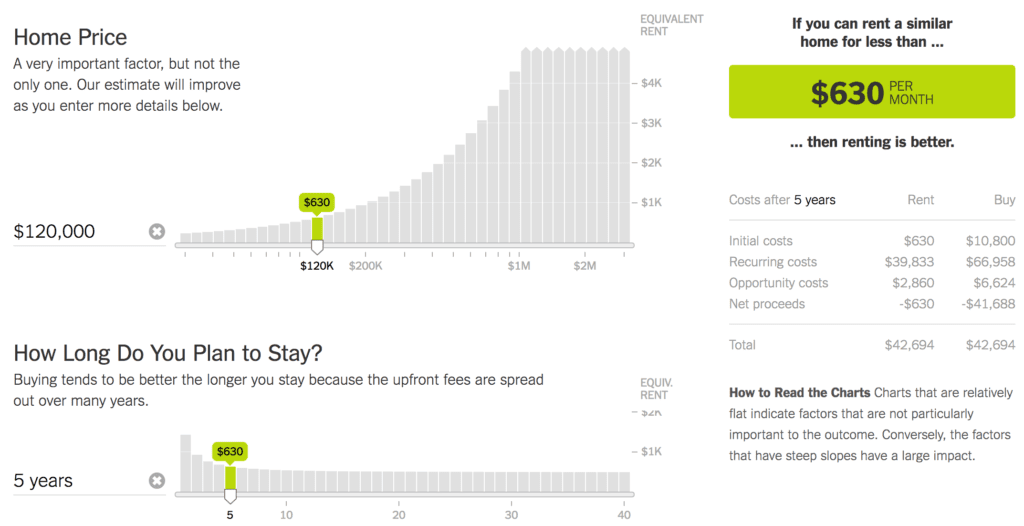
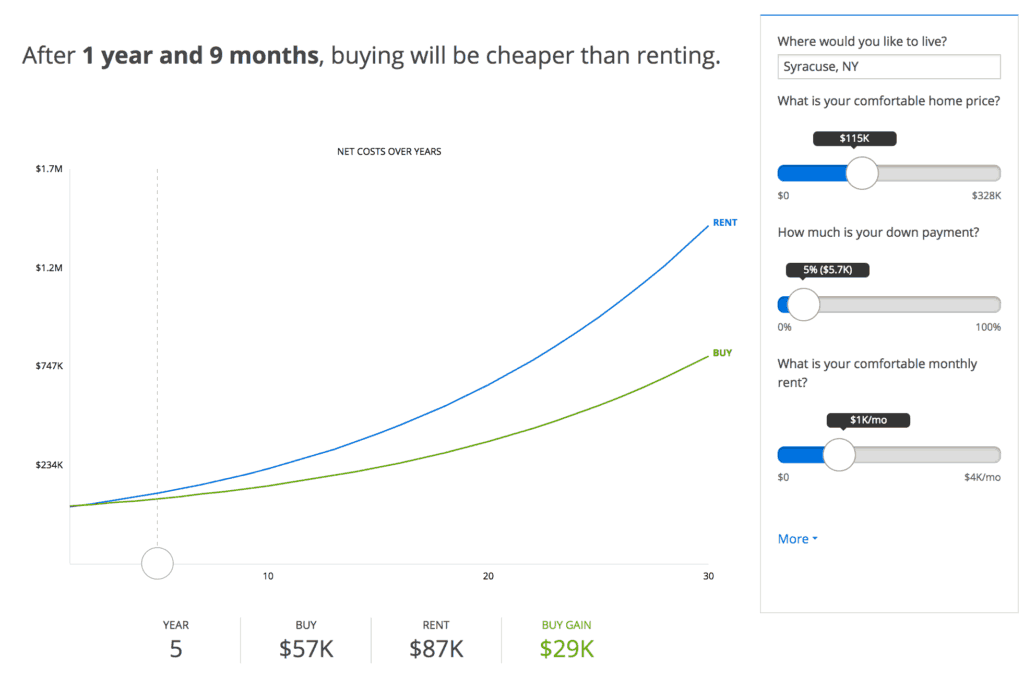
So what about the popular rent vs. buy calculators? We tried 7 different rent vs. buy calculators (each with their own methodologies) and the ALL TOLD ME TO RENT. Did I listen? Nope.
But they are worth checking. My two favorite free rent vs. buy calculators from Zillow and My App. Let’s check out the results below (making a some assumptions about salary as a policeman and using the average home price + 20% to give him some flexibility!)
New York Times Rent vs. Buy Calculator – Buy!
Syracuse Buy Home

Zillow Buying vs. Renting Calculator – Buy!
Zillow Real Estate Tracker

We’ll there you have it. You should definitely be buying in Las Vegas.
FYI: It’s a no brainer to buy a multi-family home and renting part of the space where you live. There are some properties for sale in the Las Vegas market that have 2-4 units, so renting one out and putting that rent towards the mortgage makes buying an even better decision.
Happy house hunting!

Monday, November 11, 2019

How To Buy A House When You Have Student Loan Debt


Student loan debt can be a drag, especially if you’re trying to buy a house. Fortunately, there are options. By taking advantage of the right loan programs, working on your credit and debt to income ratios and teaming up with the right partners, you can improve your chances significantly (not to mention, lower the cost of buying a home — both up front and for the long haul). 
The common outlook is bleak: student loan debt is preventing borrowers everywhere from living The American Dream.
Here are 8 ways to maximize your chance of buying your dream home -- even if you have student loan debt.
Here are 8 action steps you can take right now:
1. Focus on your credit score
FICO credit scores are among the most frequently used credit scores, and range from 350-800 (the higher, the better). A consumer with a credit score of 750 or higher is considered to have excellent credit, while a consumer with a credit score below 600 is considered to have poor credit.
To qualify for a mortgage and get the best mortgage rate, your credit score does matter.
2. Manage your debts
All lenders evaluate your debt-to-income (DTI) ratio when making credit decisions, which could impact which loan and the interest rate you receive.
A debt-to-income ratio is your monthly debt payments as a percentage of your monthly income. Lenders focus on this ratio to determine whether you have enough money to cover your living expenses plus your debt obligations.
Since a debt-to-income ratio has two components (debt and income), the best way to lower your debt-to-income ratio is to:

  • repay existing debt;
  • earn more income; or
  • do both
  • Pay off the balance if you have a delinquent payment
  • Don't skip any payments
  • Make all payments on time (if not early) 
  • set up automatic balance alerts to monitor credit utilization
  • ask your credit card to raise your credit limit (this may involve a hard credit pull so check on this first)
  • pay off your balance multiple times a month to reduce your credit utilization

3. Pay attention to your payments
Payment history makes up 35% of your FICO so it's super important. 
Since your payment history is one of the largest components of your credit score, to ensure on-time payments, set up autopay for all your accounts so the funds are directly debited each month.
FICO scores are weighted more heavily by recent payments so your future matters more than your past.
4. Get pre-approved for a mortgage
Too many people find their home and then get a mortgage.
That's backwards!
Get pre-approved with a lender first. Then, you will know how much home you can afford.
To get pre-approved, lenders will look at your income, assets, credit profile, employment, among other documents.
5. Keep credit utilization low
Lenders also evaluate your credit card utilization, or your monthly credit card spending as a percentage of your credit limit.
Ideally, your credit utilization should be less than 30%. If you can keep it less than 10%, even better.
For example, if you have a $10,000 credit limit on your credit card and spent $3,000 this month, your credit utilization is 30%.
6. Look for down payment assistance or grants 
There are various types of down payment assistance, even if you have student loans.
There are federal, state and local assistance programs as well so be on the look out or ask your mortgage expert to see which ones you are eligible for. 
7. Consolidate credit card debt with a personal loan
Option 1: pay off your credit card balance before applying for a mortgage.
Option 2: if that's not possible, consolidate your credit card debt into a single personal loan at a lower interest rate than your current credit card interest rate.
A personal loan therefore can save you interest expense over the repayment term, which is typically 3-7 years depending on your lender.
A personal loan also can improve your credit score because a personal loan is an installment loan, carries a fixed repayment term. Credit cards, however, are revolving loans and have no fixed repayment term. Therefore, when you swap credit card debt for a personal loan, you can lower your credit utilization and also diversify your debt types.
8. Refinance your student loans
When lenders look at your debt-to-income ratio, they are also looking at your monthly student loan payments.
The most effective way to lower your monthly payments is through student loan refinancing. With a lower interest rate, you can signal to lenders that you are on track to pay off student loans faster. There are student loan refinance lenders who offer interest rates as low as 2.50% - 3.00%, which is substantially lower than federal student loans and in-school private loan interest rates.
Each mortgage lender has its own eligibility requirements and underwriting criteria, which may include your credit profile, minimum income, debt-to-income and monthly free cash flow.
Student loan refinancing works with federal student loans, private student loans or both.
If you follow these 8 things, you'll be better equipped to manage your student loans and still buy a home.

Monday, October 21, 2019

Is a 30-year or 15-year Mortgage Right for You?

Mortgages are unique like you and I and there is not a "one size fits all."
One of the choices is the loan term: A 30-year mortgage can make your payments more affordable, but a 15-year mortgage may have a lower interest rate. As you're considering your home loan options, here are the most important things to know.
A mortgage is a type of term loan, meaning the amount you borrow is repaid over a set period of time. You make principal and interest payments according to an amortization schedule that's set by the lender. Your monthly payment schedule may also include homeowners insurance and property taxes if those are escrowed into your payment. Private mortgage insurance is also added whenever you buy a home with less than 20% down.

How to Choose a Mortgage Term:

  • How long you plan to stay in the home
  • The amount you plan to borrow and how much you'll put down
  • What size mortgage payment you can reasonably afford
  • How a mortgage payment affects your ability to pursue other financial goals

There are several reasons to choose a 15-year over a 30-year mortgage.When you have a 15-year mortgage, the total amount you have to repay is spread out over 15 years, or 180 payments. If you choose a 30-year mortgage instead, you repay the loan over 30 years, or 360 payments.
Pay the home off more quickly with a 15yr mortgage.
The monthly payments will be larger than a 30yr mortgage, allowing more money to go to the principal in a shorter amount of time. Your loan balance decreases faster, which depending upon when you purchased might be important to you if you envision a retirement that doesn't include mortgage debt.
Lower interest rate.
Some lenders see a 15-year term as less risky. That may translate to a lower interest rate compared with a 30-year loan. Depending on the overall interest rate environment, rates for a 15-year mortgage may be a half a percentage point or more lower than 30-year mortgage rates.
Less interest paid over the loan term.
A lower interest rate also benefits you in another way when adding up the total interest paid on the life od the loan. 
Build equity faster.
Home equity represents the difference between what your home is worth and what you owe on the mortgage. When your monthly payment is larger with a 15yr because your loan term is shorter, you can build equity at a quicker pace because you're paying more of the loan principal down each month compared with what you would with a longer mortgage.
What's great about 15-year mortgages versus 30-year mortgages is also what makes them less attractive for certain homebuyers: the larger monthly payment.
In getting your mortgage you need to be concerned with ensuring that the monthly payment is manageable than the total interest paid over the life of the loan.  Paying off your mortgage over a longer period of time can free up cash to do other important things, like investing, saving for college or retirement, and paying for renovations.  And if you have extra money to pay towards principle you can pay down a 30yr mortgage in about 17 years.
Another reason to reconsider a shorter loan term is how long you plan to stay in the home. If you plan to move within the next five years, for example, then being able to build equity faster or get a lower interest rate on the loan may not be as important in deciding which kind of mortgage to get.
A 30-year home loan has its advantages. 
Lower monthly payments.
You don't need to be a math genius to understand that a longer loan term can reduce your monthly payment. That might be attractive if you want to be able to work on other financial goals while you pay down your home loan. If you're getting a larger mortgage, being able to pay over 30 years could make the payments more affordable for your budget.
Payment flexibility.
While you're agreeing to a 30-year mortgage term, you can still choose to make extra payments. That could help you pay the loan off ahead of schedule.
More potential for tax savings.
Interest on home loans is tax-deductible. When you have a 15-year loan, you're paying off more of the interest upfront, so you may not benefit from the tax deduction as long as you would with a 30-year mortgage instead.
There are some drawbacks to choosing a 30-year home loan over a shorter term.
As the earlier example showed, the biggest drawback is interest. Not only can you end up with a higher interest rate on a 30-year mortgage, but you'll also pay more total interest on the loan. That assumes, of course, that you stick with the same loan term and don't refinance to a shorter mortgage at any point.
Refinancing from a 30-year loan to a 15-year loan could save you money if you're able to get a lower interest rate. Whether refinancing makes sense depends largely on the difference between your current interest rate and the rate you'd qualify for, as well as how much you still owe on the mortgage. Keep in mind that refinancing involves costs and possible upfront expenses since you have to pay closing costs. You could roll those into your loan, but that could make your monthly payments higher.
The best way to evaluate whether a 15- or 30-year mortgage is better is to consider your short and long term goals. 
Specifically, think about:
Timing is particularly important because of how mortgage payments are structured.
In the first 10 years of the mortgage, over two-thirds of your monthly payment is comprised of interest, so if you don't plan on living in your home for more than 10 years, you'll end up paying a lot of interest but only paying down very little of the original principal.
Thinking big picture, in terms of your larger financial goals, can help you decide which loan option is a better fit for your situation.
If the goal is to build quick equity and pay off the loan sooner, then a 15-year plan is a good one.  If you are buying a home long term and has no intent on using equity, perhaps a 30-year loan would be more appropriate, especially if you can't afford the higher monthly payment.

When in doubt, meet with your local mortgage expert and talk about your goals.  Then have your mortgage expert run the numbers for both the 15- and 30-year terms. This can put the short- and long-term financial implications in perspective so you can make an informed decision.